
American Pencil History at Sutter’s Fort
I live extremely close to Sutter’s Fort in Sacramento, California so, a few weeks back, my wife and I decided to take a walk over to the fort and brush up on our history. As we walked through it’s mud brick walls, we learned about role the fort played in the gold rush and how it served as a safe haven for early settlers. At the end of our tour, like any tour worth its salt, we had an opportunity to take a stroll through the fort’s gift shop, where one particular gift caught my eye.
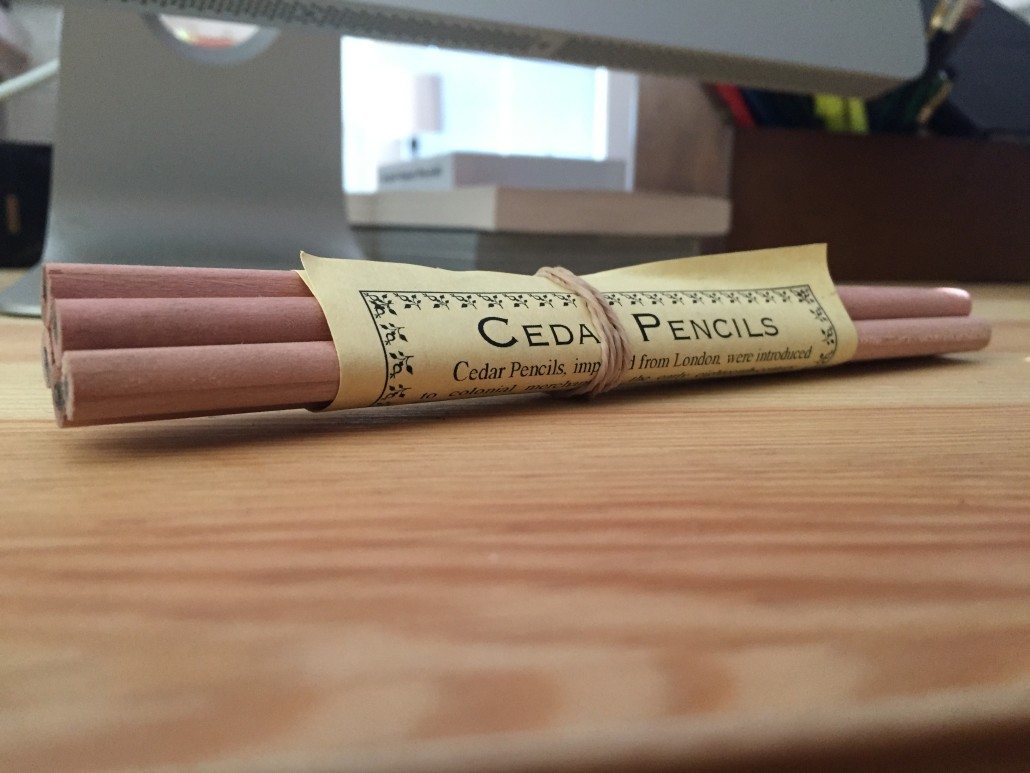
These pencils, which are labeled simply as “Cedar Pencils,” come bundled in quantities of five. Each bundle comes with a small piece of paper that gives a bit of pencil history as it relates to early America.
“Cedar Pencils, imported from London, were introduced to colonial merchants in the early eighteenth-century. These pencils were made by placing a long cylinder of lead between two pieces of glued cedar. Before they imported cedar pencils, the early colonists used heavy pencils consisting of powdered graphite mixed with clay. The imported pencils were much easier to hold and use. They were unfinished and did not have erasers like today’s pencils. A knife was used to sharpen a point on one end of the pencils.
When graphite was discovered, it was thought to be a type of lead and was called black lead or “plumbago.” The name graphite comes from the Greek word “graphein,” which means “to write.” These cedar pencils contain no actual lead.”
Unfortunately, as I sharpened up my first pencil this morning, I discovered these pencils don’t contain any actual cedar either. Or, at least no Incense-cedar. Judging by the grain and the scent (my two go-to wood indicators), I’d say these pencils are actually made out of a stained basswood; still a fine wood for pencils, but not necessarily the best wood for pencils named “Cedar Pencils.”

Despite that (fairly major) shortcoming, these pencils are fun. Each pencil is unfinished and unbranded, a simple barrel of graphite and wood. They don’t feature a ferrule or eraser, and the graphite feels like a standard, if scratchy, HB. Strip away all of the fancy designs, finishes and stories, and you’ll find what every pencil should be judged on: the quality of its graphite and the quality of its wood.
Or how well the pencil holds up while keeping a daily ledger of grain supply during the 1800s.




Leave a Reply
Want to join the discussion?Feel free to contribute!