
Handy Notebook Organization Tips

I sincerely hope you’re still using a paper notebook. No, really. While services like Evernote turn paperless note-keeping into a tantalizing possibility, we’re champions of the tactile sensation you get from rifling through the pages of a crinkled notebook for that essential bit of content.
Who said that you had to rifle through an unorganized, frenzied mess of half-jotted fragments? With some help from the web, we’ve come up with a few notebook organization techniques to help you optimize your organizationally-challenged note-keeping for future reference.
Notebook Tags
Image: highfivehq.com
Courtesy of Adam Akhtar at highfivehq.com comes this organizational tip for identifying your notes with simple, descriptive tags marked along the edge of your pages.
Say you write a Chinese recipe onto a page at the front of your recipe notebook, Akhtar writes. You would file this page under ‘Chinese’ in your table of contents at the back of your notebook, ‘Chinese’ being the first tag on the page. You would then make a mark at the edge of your table of contents page next to the line where you wrote the ‘Chinese’ tag.
On the page with your Chinese recipe, you make an edge mark at the same page. After a few pages and a few tags, you should be able to flip to the back of your notebook and using the tabs flip with ease to each Chinese recipe. Repeat the process with however many tags you can think of, and you have a handy, efficient index for quick reference.
Table of Contents
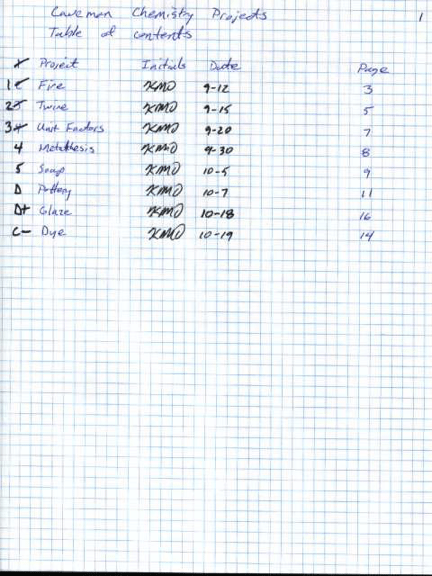
Image: http://cavemanchemistry.com/
The simple-yet-effective table of contents is an easy way to organize a notebook for future reference.
Number your pages and use the first page of your notebook to identify these pages. You can partition your notebook into sections, if you’d like, using a blank page as a divider in-between sections.
Spine Identification
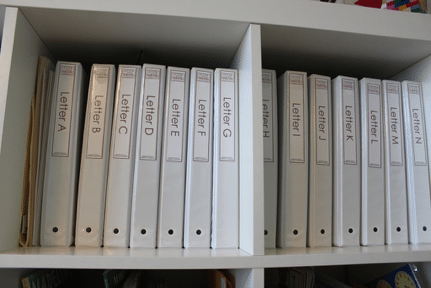
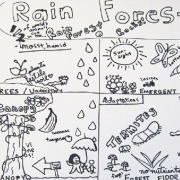
Image: confessionsofahomeschooler.com/
It sounds scary in a human context, but marking your notebooks’ spines by their content is a fantastic notebook organizer, especially if you have multiple notebooks.
Use a color-coded system, a pack of sticky labels and a pen, iconography – whatever works best for you. By separating out your notebooks by their purpose and content you’re setting yourself up for a wide range of efficiency.
The Dash/Plus System
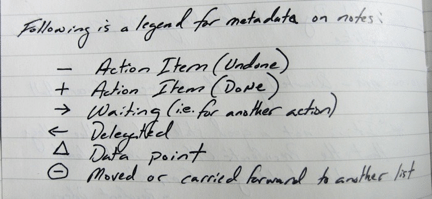
Image: patrickrhone.com
This markup system is for the hyper-productive. Using a series of symbols that build off of the basic dash (‘-‘), writer Patrick Rhone organizes his notes by action, idea, and their stages of completeness.
Here’s the simple version: Patrick marks each item in his notebook with a dash. He turns this dash into a plus sign if the item is an ‘action item’ and he has completed it. Right and left arrows indicate various stages of progress, while a triangle labels a ‘data point’ or a fact, and a circle around the dash means that the item has changed in some form.
You can read the logistics of Rhone’s system here – he claims to have used it since at least 2006.
What do you think Pencils Blog readers? Do you have any additional notebook organizational tips? Let us know in the comments!







The Dash/Plus system should be credited to Patrick Rhone. You refer to him as Mr. Hone.
It’s Patrick Rhone, not Hone.
Thanks for the catch. The post has been updated!