
An Interview with CursiveLogic’s Linda Shrewsbury
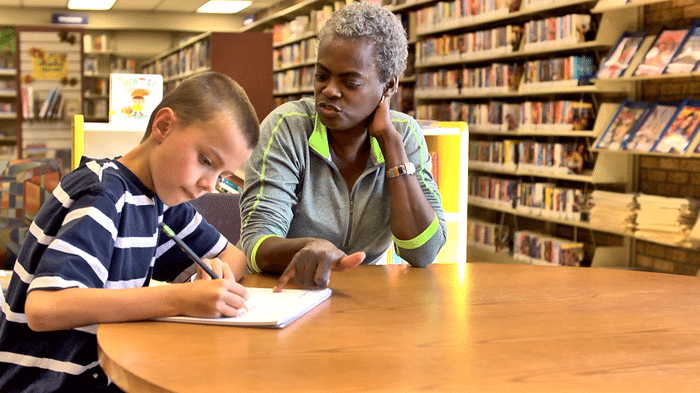
Let’s get this out of the way right off the bat: I love to write things out by hand. Even before I became entrenched in the world of pencils, pens, notebooks and the like, I loved scribbling in the margins of books, writing lists before a vacation or project and generally recording my thoughts on paper. I was the kid in grade school who argued over the legitimacy of penmanship as a subject for evaluation on the side of the teachers.
So, it goes without saying that I have been dismayed by the declining emphasis on handwriting in our school system. Luckily, I’m not the only one who has been disturbed by this trend, nor am I the only one who wants to do something about it. The difference is, Linda Shrewsbury did do something about it.
Linda is the founder of CursiveLogic, a program that not only seeks to make cursive handwriting fun and intuitive, it seeks to prove the relevance of cursive handwriting in our digital age. I had an opportunity to speak with Linda via email about the project, which is currently being funded on Kickstarter.
First, can you give us a bit of background on yourself?
My background is in education. I have worked as a teacher and a professor. I also homeschooled my three children. Two of them are assisting me with CursiveLogic.
What is CursiveLogic? How did the project come about?
I was tutoring a 23-year-old young man named Josh. He relocated to my part of the country after being displaced by Hurricane Katrina. My main task was to help Josh with his reading. But, as his reading improved and our sessions together were coming to an end, Josh told me that he wanted to learn cursive so he could sign his name. I was touched by this request and was determined to find a way to help Josh. But I feared that the time and effort required learning cursive the old-fashioned way would be demoralizing for an adult student like Josh. Josh’s request led me to create the method that became CursiveLogic. Josh learned to write the lower cursive alphabet in 45 minutes and signed his name after just one cursive lesson. Now I’ve refined the method I used with Josh and presented it in a workbook.
What makes CursiveLogic different? What are the pillars of the program?
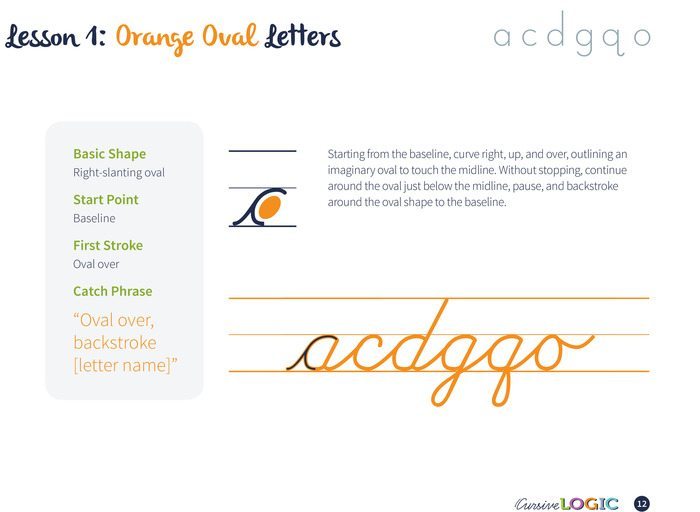
Our unique (and patent-pending) method accomplishes what previously took months in hours. CursiveLogic has two pillars—letters grouped by shape and letter strings. The entire lowercase alphabet is made up of four basic shapes, and CursiveLogic teaches all the letters that share a common shape as a single, connected string. Simplifying the teaching of letters by grouping letters with similar shapes, focusing on connecting the letters immediately, and having the student verbalize the creation of the letters while writing make CursiveLogic extremely effective.
Why do you think handwriting is so important? What’s lost when we lose handwriting?
Numerous studies have shown that handwriting has a positive effect on cognitive development that is not shared by keyboarding. With handwriting, especially with cursive, the writing itself is the personal expression of the author. The ideas I am typing now are my personal expression, but the text on your screen is not. Each person’s handwriting is unique to that person. When handwriting is lost the writing becomes less personal.
There’s been a TON of research coming out championing handwriting over typing. Why do you think this is the case? Why now?
With improvements in medical imaging technology, scientists are able to watch the human brain function in real time as it performs various tasks. They have observed that handwriting creates more activity in the brain than keyboarding which means that a person will have better memory and understanding of what he/she writes by hand.
Clive Thompson recently gave a talk on “Cognitive Diversity” (you can check out the video here). Do you agree with him? Is there a place for cognitive diversity with our children as well?
I agree with Clive that different writing methods are suited to different situations. For instance, I am typing the answers for this interview, because they need to be sent to you via email and then posted on the web. Typing also allows for an element of speed that can’t be matched by handwriting and, as Clive points out, that can be an advantage when ideas are flowing and you just need to get them down quickly.
But where Clive and I really agree is on the benefits of writing by hand. As he points out, writing by hand is far better for absorbing and retaining information as well as for encouraging big picture thinking. “Always carry a pencil and type as fast as you can,” is great advice. But it doesn’t work if you can’t use a pencil well.
It is a both/and situation. Kids need to learn to type quickly and well. But learning to type well does not replace learning to write well by hand, because writing by hand brings so many advantages that tying can’t replace.
Are you a pen person or pencil person? And, along those same lines, are there any tools you recommend to accompany the CursiveLogic Workbook?
I’m a pencil person when I journal. Using a fine point mechanical pencil with an unlined Moleskine journal really aids my thought flow.
For practicing CursiveLogic, colored Sharpies (neon orange, lime green, silver and mauve) go along with our instruction method and really add “an element of fun” to the learning process. The larger barrel size helps children especially learn correct instrument grip. I experiment with all sorts of pencil grips and pencil sizes… anything that will aid in practicing a relaxed hand and a light grip. I teach students a way of releasing the hand that I dub “the celebrity grip.” It is modeled on a hand movement alternately called the parade wave, the Miss America wave, or the royal wave. I tease my students that planning for their “15 minutes of fame” requires a “celebrity grip” and a great signature!
If you’d like to find our more about this project, head over to CursiveLogic.com. You can also visit the project’s Kickstarter page to back the project.



I applaud this effort. It is disheartening to watch my daughter’s school system forgo cursive writing. This skill is essential to development of an adult in our society. Anyone can hit a key, but they can also write in cursive.
I am really astonished when I read, that it is necessary today to install private courses to teach people cursive writing. (I think that means fluently write connected letters in what we in Germany call »Schreibschrift« other than putting together single letters of »Druckschrift«.)
In Europe, I think, it is common practice until today to teach kids write Druckschrift first and than Schreibschrift, but the discussion started: Learning Schreibschrift takes too much time, which could be used better.
That makes me sad, because my personal handwriting is a part of my personality. It changes over the years and to be true it isn’t always legible. But it is mine! I am the only one in the whole world (I hope so) who writes that way. Friends, when I wrote them a letter or postcard will see at first sight, who was the sender.
From the web one can get enough music for the rest of his life. So why should anyone learn to read notes, to play violin or piano.
Why are people sketching and painting, when their smartphone’s camera is always in reach?