
Lesson Plan: What is a Sustained Yield Forest?
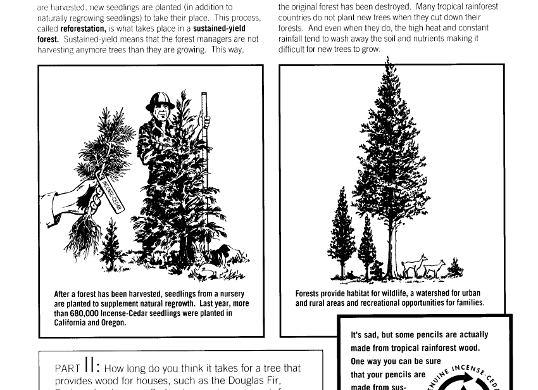
Lesson Plan: What is a Sustained Yield Forest?

Objective:
Define the concept and value of a sustained yield forest and, as a “capstone” activity, apply what was learned to a community setting. Featured learning skills:
- Critical reasoning
- Ecology
- Forestry
LESSON PLAN
Step 1: Preparation/Discussion
- Introduce the concept of a sustained yield, which may not be widely familiar to students
- Click here (Sustained Yield) and Click here (Forest Certification) to learn more about the subject and protective forest measures
- Read aloud or have the students read in silence
- Or highlight the key points and share them with the class
Step 2: Pass out activity sheet “What is a Sustained Yield Forest?”
- Set the stage for introducing the concept of a sustained yield, which may not be widely familiar to students
Part II activity sheet: Supplemental information
- Explain how different trees grow at different rates—just like people.
- Conditions related to climate, soil quality and terrain all impact growth rates—similar to how diet and nutrition impact peoples’ lives.
Part II activity sheet: Answers
- It takes four to five years for a coniferous tree (Redwood, Douglas Fir and Incense-cedar) to grow to 5 feet tall and 40-80 years for them to grow 50-100 feet high (tall enough to harvest).
Part III activity sheet: Supplemental information
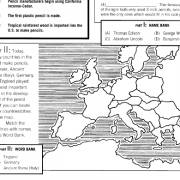
- Introduce a map of the United States and explain how some regions are heavily forested (Pacific Northwest) while others are note (the Great Plains states).
- Despite the fact that we have been harvesting trees since before the American Revolution, 730 million acres of forests still remain. Ask students to share stories of the forests they’ve visited.
Part III activity sheet: Answers The ten states with the largest areas of forested land are:
- Alaska, 129 million acres
- California 39.4 million acres
- Oregon, 28.1 million acres
- Georgia, 23.9 million acres
- Montana, 21.9 million acres
- Washington, 21.8 million acres
- Alabama, 21.7 million acres
- Colorado, 21.3 million acres
- Arizona, 19.4 million acres
- North Carolina, 18.9 million acres
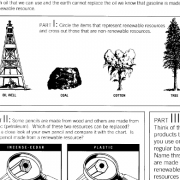
Activity sheet: Supplemental information on Tropical Rainforest Destruction:
- Expanding on the activity sheets, explain that barren desert-like areas are replacing tropical rainforests in certain countries.
- People in these countries clear the forests for many reasons, such as to build shelters, or to sell the raw wood logs to other countries.
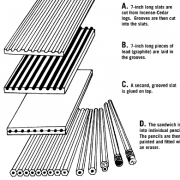
- Explain how some of this tropical rainforest wood eventually makes its way to the U.S. in the form of pencils.
- Tell the students that they can make sure they are buying pencils made from sustained yield wood grown in the U.S., and not tropical rainforest wood, by looking for the following logos: “Made from Sustained Yield Wood,” “Contains NO Tropical Rainforest Wood” or “Genuine Incense-cedar — A Renewable Resource.”
- Other kinds of tropical rainforest wood sold in the U.S. include mahogany, teak, and rosewood, woods primarily used in fine furniture or interior decoration. Although there are some sustained yield plantations of these woods, most of it does not come from such sources. In recent years, there has been some small improvement via voluntary participation in Forest Certification as well.
Optional Capstone Activity:
- Complete the unit by dividing the class into collaborative learning groups. Drawing upon everything that’s been learned about pencils, renewable resources and sustained yield forests, have each group create a presentation.
- Select a favorite format (skit, oral or videotaped presentation, computer-generated newsletter or newspaper, art exhibit, collage, sculpture, dance or song) in which to communicate the material.
- Encourage the groups to be as creative as possible, and to consider combining multiple mediums into a single presentation.
- Have the groups make their presentations to the class and, if possible, to other classes at your school.
- You may also want to arrange additional presentations for parents, school board members, the PTA or other relevant audiences.
CORRECTION NOTE: While specific figures may vary slightly from when this activity sheet and lesson plan was originally produced in 1993, the basic concepts and overall picture remain unchanged. In the case of jelutong, an Indonesian rainforest wood, this species use in pencil production has been replaced by another tropical rainforest species, Pulai. It’s of similar, but lesser quality, and is generally still referred to as jelutong even though it is not the same tree. Due to reduced forests in Indonesia, that country now imports Incense-cedar from California and Basswood from China for making pencils.



Leave a Reply
Want to join the discussion?Feel free to contribute!