
The Walt Disney Family Museum and History of Animation
 The Walt Disney Family Museum and History of Animation
Seventy-two years ago this month, Walt Disney released his second feature-length animated film to the excitement of fans and the dismay of skeptics around the world. Today, Pinocchio is remembered as one of Walt Disney’s early animation classics and Walt is remembered as one of the greatest innovators and animator’s of all time. Not bad for a poor boy from Kansas City, huh?
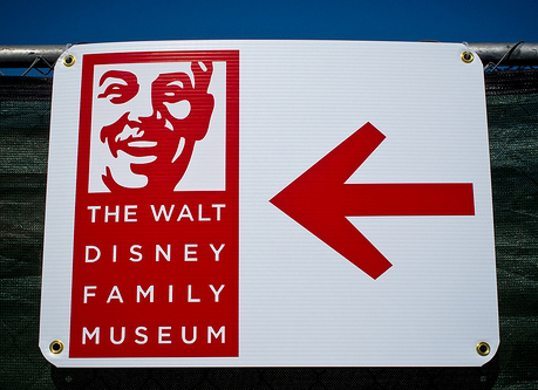
Just last week, I had the opportunity to visit the Walt Disney Family Museum in San Francisco, CA, a museum dedicated to telling the story of how Walt’s legacy came to be and how the man behind the mouse turned his dream into reality. The museum occupies one of the barracks in the historic Presidio of San Francisco and overlooks the Golden Gate bridge and San Francisco bay. If you’ve never visited the Presidio, try to make it a point to do so the next time you’re in the area. The view is breathtaking.
The museum itself is a collection of ten galleries that feature a hundreds of mementos, trophies and other important items from Walt Disney’s life. Among these items are a number of original sketches from many of Disney’s early animated films (including Pinocchio!) and handwritten letters penned and penciled by Walt himself.
The order of the museum’s galleries is chronological and linear; museum goers enter through the lobby and find themselves in the “Beginning” gallery, a gallery that features items from Walt’s early childhood and teenage years. From here, the museum leads you through the “Hollywood,” “New Horizons in the 1930s” “The Move to Features: Snow White and the Seven Dwarves,” “We Were in a New Business,” “The Toughest Period in My Whole Life,” “Postwar Production,” “Walt and the Natural World,” “The 1950s and 1960s: The Big Screen and Beyond” and “December 15, 1966” galleries on a trip that takes you from Walt’s humble beginnings, to his death in 1966.
While the main purpose of the museum is to tell the story of Walt’s life, it also succeeds in telling the story of the evolution of animation. In the early galleries, Walt’s drawings are limited to motionless comics and simple sketches but, as the galleries progress, so too do the techniques used to create his animated characters.
While browsing the museum, there were two exhibits that stood out to me for their ability to showcase just how much animation changed during its formative years. The first of these exhibits was an interactive display for the animated short Steamboat Willie that tasked participants with syncing the film’s sound effects with its animation.
Wait, time for a little history lesson.
For those of you who don’t know, early animated films, like all films, were silent and, when sound was eventually introduced, it couldn’t be dubbed like it can today. Instead, the orchestra, sound effects crew and voice actors would have to record their audio simultaneously while the animated film was playing. If one person was off, the entire track would have to be rerecorded from scratch.
Sounds stressful, right?
It was. I flailed away at those sound effects props for a solid twenty minutes before finally getting it (almost) right. Oh, and did I mention it was only for a thirty second clip of the film? I can only imagine the problems that arose when recording the audio for an entire film.
The second exhibit, at first glance, seemed like a simple informative video. The video told the story about the multi-plane camera was used to achieve a sense of depth in Walt Disney’s early films (including Pinocchio’s opening scene). When Walt zoomed in on a shot, he didn’t want to moon to grow larger with the trees and the barn. So, he began using a multi-plane camera to give the illusion that the objects in the foreground were growing larger while the objects in the background stayed static.
Directly beneath the video screen, however, was a glass case that contained the top portion of one of these multi-plane cameras. Where was the bottom portion, you ask? Why, directly below the top portion, of course. The massive camera towered up from the floor below and through a cut out in the second story floor, giving museum patrons the ability to look directly through the top of the camera and through the stacked panes, resulting in the same sense of depth discussed in the video.
These exhibits were just two of the dozens of high-quality, informative exhibits in the museum. Overall, the museum was an amazing experience and well worth the price of admission due to the shear volume of things to do, see, hear and watch. If you are a fan of Walt Disney himself or his legacy, any of his animated films or animation in general, do yourself a favor and check out the Walt Disney Family Museum. You won’t be disappointed.
Photo by HarshLight.





Leave a Reply
Want to join the discussion?Feel free to contribute!