
Traces of History: Pencils and the Suffrage Movement
 Traces of History: Pencils and the Suffrage Movement
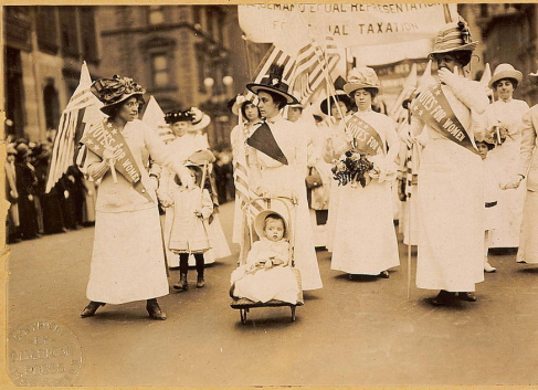
My earliest heroes were the women behind the United States suffrage movement. Susan B. Anthony, Carrie Chapman Catt, Julia Ward Howe and Lucy Stone weren’t just stuffy figures in a history book to me; they were strong, fearless and intelligent women who showed me that every woman has a voice, and that every voice has power.
I hadn’t given much real thought to those childhood heroes until my junior year of college, when an assignment for a class on the history of food led me to cookbook compiled by suffrage activists. Fifteen weeks of class, countless cups of coffee, one exhaustively-researched term paper and three all-night grant-writing sessions later, I found myself in Cambridge, MA at the Schlesinger Library at the Radcliffe Institute for Advanced Study at Harvard University.
The Schlesinger Library is home to the Women’s Archives, a rich resource of materials that chronicle everything from the suffrage movement to the rise of feminism, as well as a 20,000-title collection of cookbooks and other food-related miscellany. I requisitioned the documents I needed, settled down in the reading room, and prepared for a day of hard work.
I had expected hermetically-sealed documents in little plastic sleeves, all carefully stored in meticulous order. Instead, the first box I opened contained a riot of letters, notes, shopping lists, musings, notes and bills. The words flew across the pages with electric energy, as though the pen or pencil could barely keep up with the racing thoughts of the writer. The words of all of my heroes were contained in those innocuous-looking boxes, though contained is perhaps the wrong word – they were practically bursting out with an energy all their own.
Their thoughts were scribbled in pencils, crowding the margins of old invoices, squeezing between the lines of political fliers, and tumbling across the borders of newspaper articles. The women who wrote these letters were incomparable multi-taskers; their thoughts couldn’t be confined to time at home over a lady-like desk where they could be neatly organized on personal stationery. Whatever paper and time was at their disposal was what they would use to communicate.
I sat back in my chair, breathless at the expanse of wisdom and courage in front of me. These weren’t dead documents covered in dust; they were living, breathing examples of their ingenuity and integrity. Women didn’t have many tools at their disposal in the early days of United States history; the law didn’t count them as citizens, and society told them that to be meek, quiet and submissive was to live to their fullest potential. But they had spoons, and they had pencils, and from those two humble tools they built the campaign that would win women the right to vote.
Taking a deep breath, I reached for my pen to begin taking notes, but suddenly I remembered – no pens in the reading rooms, only pencils.
I stopped, and I smiled. And I haven’t picked up a pencil to this day without remembering Lucy, Susan, Carrie and the women who fought for the vote. The lines they left behind – some faint as a cobweb, some as bold as a lightning bolt – have stayed with me, and remind me that one’s voice, and one’s words, have the power to change the world.


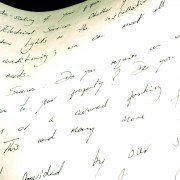





This article hit so close to home I felt as if I needed to duck to avoid being hit by the memories of the archive reading rooms I have sat in going over documents of the past. One of my most valued treasures from my mothers collection of writings was a one page journal type writing of a great-aunt who had used what today we would call a child’s paper (newsprint) pad, her writing, an older style of cursive writing so very faintly and beautifully written page thrilled me so. The writing has long ago faded to nearly nothing, but this article so clearly brought back to me the memory of that piece of paper and the notes my mother left. She never used a journal, but left notes and phrases of poetry jotted down in ball point pen or pencil on any old scrap of paper from napkins to envelopes, to the edges of magazine articles and newspapers. Little snippets of her life.
Thanks for the walk down memory lane and the joy it brought me this morning.
Thank you so much for your comment; I’m glad that those moments and treasured letters had such an impact on you, and that that the Studio could start your day happily. To make a reader smile always makes my day too!
For those readers who might be interested, the book that first introduced me to women in history was “They Led the Way” by Johanna Johnston. To read about women like Emma Willard, Victoria Woodhull, Phillis Wheatley in a book that was aimed toward young grade school readers had a profound impact on my life, and I highly recommend it for young readers.