
Have You Read Your Mark Twain Today?
 Have You Read Your Mark Twain Today?
Trying to write about Mark Twain on this, the 176th anniversary of his birth, is a distinctly daunting task.
For one, the man born Samuel Clemmens is responsible for some of the greatest novels of all time. “The Adventures of Tom Sawyer” and “The Adventure of Huckleberry Finn” are two of the finest novels the genre has ever produced, but even the minor works (“A Conneticuit Yankee in King Arthur’s Court,” “The Prince and the Pauper”), short stories and vignettes (“The War Prayer” and, a personal favorite, “The Celebrated Jumping Frog of Calaveras County”) are written with such intelligence, verve and power that to say anything other than “Drop what you’re doing and read some Twain NOW,” seems superfluous.
There is also the fact that even now, over one hundred years after his death, Twain’s work provokes such passionate debate over race, censorship, ethics, and the American experience that to try and find something trenchant and original to add to the clamor becomes more of a vanity exercise than anything else.
It doesn’t help that Mark Twain was also one dry, witty, sarcastic son-of-a-steamboat pilot whose artistry with words has left us with anthologies, websites and countless quote-of-the-day calendars stuffed with observations that run from lacerating to poignant in a single breath..
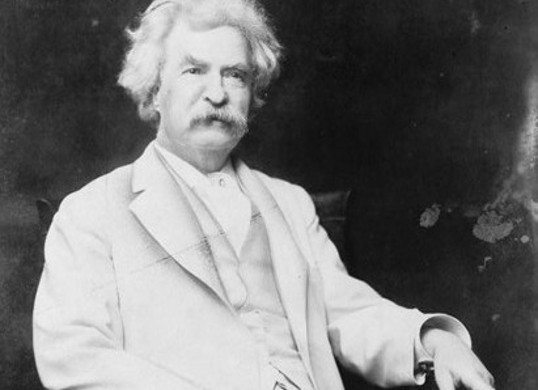
If that wasn’t enough, Twain compiled a list of rules for writers (oh-so-handy for vivisecting his contemporaries, as he did with James Fennimore Cooper, in whose honor he composed this list) that have one constantly sneaking furitve glances behind one’s shoulder, just in case the irrascible genius in the iconic white suit should pop up, glowering over his cigar at the myriad of ways in which you have just mangled the English language.
I fear I am in grave violation of at least a half a dozen of his rules at this point.
So, in honor of Twain’s first rule of the author, (“The author should say what he is proposing to say, not merely come near it,”) let me say this.
Mark Twain is the finest author America has ever, and likely will ever, produce. While his books are among some of the most frequently banned in the United States, they should be required reading for every man, woman and child, starting with the unexpurgated “Huckleberry Finn.”
Yes, Twain uses language that stuns and horrifies the reader. Yes, he portrays a time and place in American culture that was cruel, dark, and twisted, where the kindliest faces could hide some of the ugliest souls.
But he also wrote tales where people learn, where they look their ugliest prejudices and closest-held assumptions in the face and say, if this is what is good and right, then all right – “I’ll go to hell.” They are stories that confront the universality of our darkest tendencies, but also celebrate our ability to learn, to be better, to overcome, to redeem ourselves.
He is the most human author we’ve ever had. And if you are wise, by now you have stopped reading this and picked up the pages of Twain for yourself.






Leave a Reply
Want to join the discussion?Feel free to contribute!