
Word by Word: The Lost Art of Penmanship
 The Lost Art of Penmanship
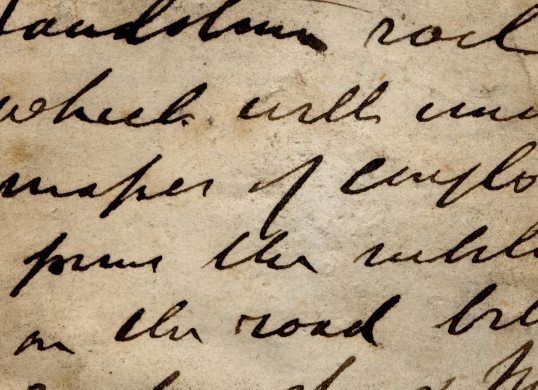
I peer through the magnifying glass, squinting at the delicate letters in front of me. They are as thin and spidery as the webs I bushed away when I took the letters out of their battered cardboard box, and my eyes can only barely make out some of the loops and swirls of the author’s penmanship as the words arc across the page.
Frustrated, I sit back in my chair, blink rapidly, and try to regain focus. It’s going to be a long afternoon.
In the times of men women like my great-grandmother, penmanship was more than just a way to communicate – it was an art form. Elementary and primary schools regularly gave prizes for the best penmanship among their pupils, and methods of handwriting were hotly debated – did you prefer the Palmer Method? Were you an acolyte of the Crosby and Nichols Theory of Penmanship? This wasn’t just kid’s stuff – even well-respected businessmen regularly sent away to correspondence courses that would help them improve their handwriting. After all, a business letter might be the first contact they would have with a potential client, and they wanted to put their best foo- I mean, hand forward.
With the rise of texting and other short-hand forms of digital communication, many have bemoaned the new vernacular that determines how we communicate – “BRB” for “be right back” “Y” and “U” for…well, “Why” and “You.” But I think that the equally tragic loss is our loss of penmanship. To take time to perfect your words wasn’t the work of an idle moment. It showed that you cared enough to put your best self forward. While there are still some hard-core devotees of penmanship out there, they grow fewer and farther between as time goes by.
It’s painstaking work, but slowly I return to the series of old love letters that sit on the desk before me. Hidden in the whorls and sweeps of the script are the longings of a pair of a lovers, now long dead, who used to inhabit my hometown. It’s not just the words that chart their hopes, fears and dreams – it’s the excited flicks of the pen scurrying across the page during one particularly frantic missive; it’s the cramped squiggles that crowd the border of the page as the writer runs out of paper and space.
Is it any wonder that when font designers develop a type that bespeaks gentility, romance and elegance, they turn to the lost art of penmanship for inspiration? Improving your own handwriting doesn’t require sealing wax, quill pens and parchment paper – a pencil and a sheet of binder paper are ideal. In fact, the rulings on the binder paper can help you regulate your handwriting, providing the framework for a cursive script that might just help you write some love letters of your own. And a pencil helps you get rid of any mistakes as you copy “The quick brown fox jumps over the lazy dog” over, and over, and over again.
Robert Brault once said, “The average pencil is seven inches long, with just a half-inch eraser – in case you thought optimism was dead.” Maybe penmanship is a sign of optimism too – we may make mistakes, we may stumble in our attempts, but we continue on, word by word, line by line.
Photo credit: Hisks/Stock.Xchng






There are signs that handwriting’s making a comeback …. As a handwriting improvement/remediation specialist, I do a fair amount of correspondence school” teaching (via e-mail and scans) for business people.
It’s heartening to know that handwriting is making a comeback! If I can ask, what are some of the most common patterns of bad handwriting that you see as a specialist?
I must have been part of the last group to learn the Palmer Method of handwriting. Predictably it deteriorated over the years but if I take the time, I can turn out some nice handwriting. A couple of years ago I read about how impractical the Palmer Method turned out to be compared to the simpler Spencerian styles, so I taught myself a form of simplified Spencerian, which IS faster and is retained better when rapidly writing.
It’s so nice to know that a few other people are still interested in handwriting.
When I was a kid, Martha Stewart Living had a tutorial on the Palmer Method, and I found it so intriguing that I copied it over and over into a spiral-bound notebook until my chicken-scratch was something a little more elegant. I agree, my Palmer goes downhill when I’m writing quickly, but it does make for some nice thank-you notes and letters!
I think it is wonderful that you made such an effort to improve your handwriting! I enjoyed learning and practicing the modern Spencerian and I intend to continue practcing it. When I was in grade school we were not allowed to write with ball point pens until 7th and 8th grades, and only used fountain pens for penmanship and our final drafts of writing. About five years ago I became interested in pencils through my nostalgic search for fountain pens.
The more I read and learn about the Spencerian method, the more I’m convinced that learning it has to be one of my next projects! Do you have any tips for novices of the art?
If you’re looking for inspiration, please check out our Facebook penmanship contest – it’s proof that the art of penmanship really is thriving! Who knows, you might even like to enter it yourself!