
An American Tale: Folktales Built on Creative Contributions
 An American Tale: Folktales Built on Creative Contributions
Some stories are meant to be written down, and their permanence preserves the creativity of the writer. The beauty of folktales is that they are meant to be told and retold, and therefore embody the creativity of a whole group of people for generations. American tales are many and varied, just like the people who tell them.
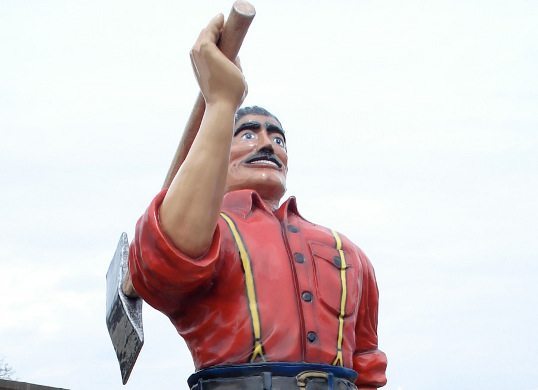
Perhaps the most famous hero of American folklore is Paul Bunyan. Many stories tell of the giant lumberjack’s unusual birth – how the moment he was born he began to grow and didn’t stop until he towered above the treetops, or how it took five storks to deliver him to his proud parents. In most tales he is accompanied by Babe the Blue Ox, his loyal companion whom he rescued from the snow. The myth of Paul Bunyan has inspired statues of the lumberjack and his ox throughout the United States. Most of them are big enough for the average person to take a seat on the toe of Paul’s boot or in the palm of his hand.
A huge part of American folklore is Native American folklore. Some Native American folktales have even evolved to become a part of popular culture, such as the Muscogee tale of the Terrapin and the Rabbit. Unlike the story of the Tortoise and the Hare, however, it is not the Hare’s confidence that is his undoing; rather, the Terrapin tricks the Rabbit by having his relatives carry a white feather and pretend to be him so that the rabbit thinks he sees Terrapin ahead of him throughout the race, while the real Terrapin is sitting at the finish line the whole time. This example illustrates the importance of folktales as spoken, rather than written, stories.
Once something is written down, there is a tendency to emphasize accuracy in its recounting, and any variation becomes an error. This kind of thinking is death to folktales. Oral tradition is like a game of telephone that extends through generations, and some information will necessarily be altered, adapted, and reinterpreted along the way. While your English teacher may not be thrilled with your essay on Romeo and Juliet where you insist on adding a scene in which Juliet professes her love for the Friar and they fly away together on a purple dragon, creative contributions to folktales are welcome and encouraged, and ensure that the art of oral tradition remains alive and well in America.
What do you think Studio 602ers? What’s your favorite American tale? Sound off in the comments below!





Leave a Reply
Want to join the discussion?Feel free to contribute!