
Illustrations and Illustrators: Bringing Words to Life
Illustrations and Illustrators: Bringing Words to Life
 What exactly is illustration? When this question was posed to me, I had a difficult time answering it. I knew children’s books were illustrated, I knew comic books were illustrated, but I couldn’t put into words what exactly an illustration was and what separated it from a drawing or a doodle. Needless to say, I went looking for answers.
I first turned to a book aptly titled What is Illustration? On the first page of this book, its author Lawrence Zeegan attempts to answer my query by stating, “illustration isn’t art and it isn’t graphic design…” it is “somewhere in between.” This something in between Zeegan calls “graphic art,” a term he seeks to explain in the book’s 256 subsequent pages. In the end, despite the book’s title, the author’s entire definition is predicated on what illustration is not, rather than what illustration is, leaving this reader disappointed and even more confused. I then looked deeper to my own misconception of what the word means to try and eke out a definition of my own.
To many, the word “illustration” is synonymous with the word “drawing,” but these words have two very distinct meanings. Merriam-Webster defines drawing as “the art or technique of representing an object or outlining a figure, plan or sketch by means of lines.” Illustrating, on the other hand, is defined as “a picture or diagram that helps make something clear or attractive.” The difference, then, is in the intent. A drawing can be created for any reason. An illustration, on the other hand, is made with the intent of making something clear or attractive. For lack of a better word, an illustration is made to illustrate.
Comics are the perfect way to demonstrate this idea. Every comic has two bylines: a “written by” byline and an “illustrated by” byline. While both of these bylines can be occupied by the same name, they represent two very different aspects of the comic: the comic’s story and the images used to represent them. A comic’s story is much more than the words that appear in the comic’s pages; it is the composition of every scene and the emotions on every character’s face. It is the smell of the air and the sound of the earth beneath the characters’ feet. It is the illustrator’s job to transform these scenes, emotions, sounds, smells, etc. from words into images. It is the illustration’s job to bring words to life.
Illustrations appear all around us: on billboards and in advertisements, in books and on movie posters. Whether the image appears above a funny caption in your favorite magazine or on the bottom of a skateboard deck, so long as the image seeks to adorn, clarify, decorate or bring words to life, it is a form of illustration. One could even make the claim that the most simple cave drawings left over from ancient civilizations are the earliest forms of illustration, and it would be a tough claim to dispute.
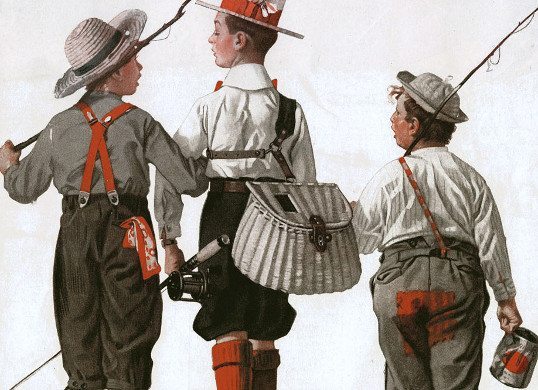
While Lawrence Zeegan may believe illustration is not art, I would beg to differ. Some of the most well known works of art from the past century are illustrations or derived from them, though you might not think of them as such. The iconic works of Norman Rockwell are almost all illustrations. Andy Warhol, who himself started out as a commercial illustrator, based many of his works, including the infamous Campbell’s soup pop art, off of illustrations. Simply because these works are easily accessible and act as “commercial art” does not mean they cannot be works of art at the same time. Or does it?
What do you think Studio 602 readers? Now that we know the definition of “illustration” are illustrations a form of art? Or, are they something in between? Let us know what you think in the comment section below.





Leave a Reply
Want to join the discussion?Feel free to contribute!