
The Perks of Handwriting: 7 Reasons Every Writer Should Write by Hand
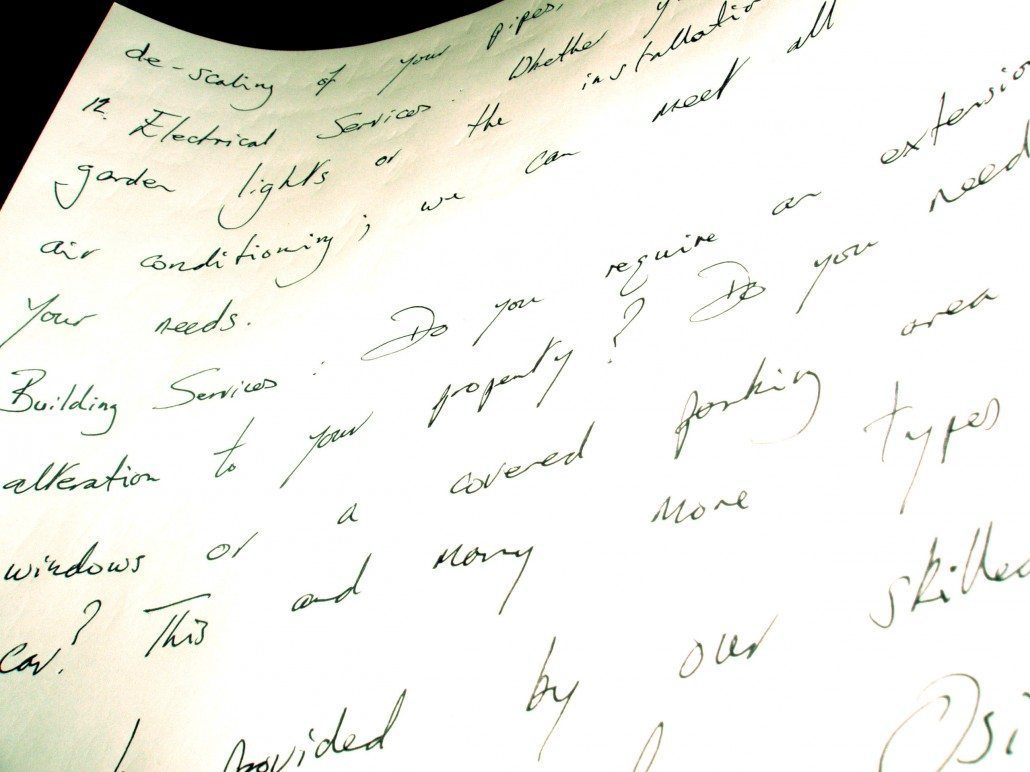
 With a keyboard or touchscreen within reach at any given moment, handwriting is becoming something of a lost art. There are some aspects of handwriting, however, that other writing methods can never replicate or replace. Here are seven reasons every writer should continue to write things out by hand.
7 Reasons Every Writer Should Write by Hand
Writing by hand adds personal character
If two people sitting at matching Underwoods were asked to type the phrase “an orange orangutan,” the two mostly blank sheets of paper would come out practically indistinguishable. If those same two people were then asked to hand-write the same phrase just below where it had been typed, it is highly likely that a distinction between the two samples would become clear. There are a number of traits handwriting can display that become lost in the homogeneity of typed print. Slanted letters, hurried slop, careful fastidiousness, or writing in all capitals (a practice far more acceptable in penmanship than in type) are all possible indications of a writer’s personality.
Since an author’s final draft is typically in typed form, these quirks remain hidden to audiences, but a creative author can use this as a character building tool. For example, a novel could include journal entries from its characters that appear in their own penmanship. Readers could then better understand the attitudes and emotions of characters not only by the tone of these entries, but also in the manner in which they were handwritten.
Pencils are handy for more than just writing
Descriptive language is a crucial part of any great writer’s repertoire, but sometimes a description, no matter how vivid, isn’t the most appropriate method of conveyance; sometimes an author may want to actually show the reader an idea outright.
Authors such as J.R.R Tolkien and Kurt Vonnegut would often incorporate hand-drawn sketches into their works as a way to depict their ideas. Tolkien would include detailed maps in his beloved fantasy novels to help readers keep track of his heroes’ trek across sprawling fictitious geography, and Vonnegut was known for including drawings midway through a paragraph to give a stylized visual of what is being described. There’s more than one way to skin a cat, and likewise, there’s more than one way to portray a cat in a novel.
Less temptation for those who are prone to procrastination
Handwriting in a notebook can open a world of productivity for the procrastinating novelist. Why is that? It’s quite simple really. It can’t connect to Wi-Fi.
The internet, in all its vastness, is a fantastic tool for discovery and creativity, but it can also be a pit of unproductiveness. With a pad and pencil there is only the artist and their art. Of course, it’s still easy to get distracted from work when writing by hand, just not as easy as clicking “new tab” on a browser.
Easy mobility
One the greatest benefits of writing by hand is that a pencil and notepad can be brought anywhere, which is immensely helpful for a writer fishing for ideas. One’s own desk can only provide so much inspiration, after all.
I realize that with today’s technology there are common devices, such as phones, that have notepads that can be used to type up the ideas that present themselves unexpectedly in the grocery store, but typing extensive details can be tedious on a small keypad or touchscreen. Plus, there’s no need to worry about a pad and pencil running out of battery. Running out of paper may be an issue, but worry not, napkins are much easier to come by than phone chargers.
Taking part in the continuation of an ancient literary tradition
Every great writer before the 19th century (and many well beyond that) composed their works by handwriting. It’s been the primary method of written communication for thousands of years, and has only recently, relatively speaking, been met with competition: the typewriter and computer. In many ways, writing a novel longhand is an act of solidarity that ripples throughout the ages. I know it’s a club I’d like to be a part of one day.
Writing longhand can help slow down and manage a thought process
For most people that have equal experience with handwriting and typing, the latter can be a much faster process, but in good writing, speed isn’t everything. The slower pace of longhand can help a writer manage their ideas, giving them enough time to completely think them through. It’s difficult to fully realize and develop an idea when the words are being typed at a faster rate than the thought even had a chance to breathe.
There’s a sense of composure that is taught by handwriting that isn’t needed when typing. If I make a mistake when writing on my computer, or feel like a sentence is in the wrong spot of a paragraph, I can highlight and delete or copy and paste myself back on track in a matter of seconds. Errors such as these aren’t as easy to deal with when handwriting, and because of this, writers who practice longhand learn discipline, a trait that benefits one’s life immensely.
It’s inexpensive
Not every aspiring writer can afford an expensive computer. Thankfully, a few dollars can buy a person some pencils and a notebook that’s just waiting to become the first draft of a bestseller.
What do you think Studio 602ers? What are the benefits of writing things out by hand? Sound off in the comments section below!









I could NOT agree more! An 8th reason to practice writing by hand is because, even with technological advances, we STILL have to be able to sign our name to many things. I thought you might be interested to know (if you don’t already) that Shelby Foote, a Civil War historian and author who died just a few years ago, wrote every single manuscript and piece of correspondence with a dip pen. Now, you probably know this but, just in case, a dip pen is basically a stick with a nib or tip on it. There is no ink in it at all. You dip the nib in a bottle of ink, write a few letters, then have to dip again. It takes a LONG time to write anything. Still, he used dip pens for all of his writing until his dying day. And, just so you know, the books he wrote were often 800 pages or more. Considering that it usually takes two or more handwritten pages to make up one printed page, that is a LOT of dipping! I LOVE handwriting — love to send and receive handwritten letters, love to write in journals and notebooks, I am the one who is always taking notes in church and at work. I appreciate this post very much!
Shelby Foote did indeed write his wonderful Civil War history with a dip pen! I was at a book conference years ago when he mentioned this. He also estimated (or did he know for sure?) that he wrote a million words. And he ordered the nibs in bulk in case they went out of business. Thank you, Cindy, for reminding me of this delightful man and the book conference long ago.
I think you have a very well thought out article with some great points. Hand writing is becoming a lost art. When I receive a handwritten note or card it has so much more meaning because of its personal touch. We can do so much with a pen and paper; it’s a shame that is being forgotten. Thanks for the read I found it to be very inspiring.
I could not agree more about the notation process. There is nothing that can replace the tactile satisfaction from writing with a good pencil and nice notebook. I use many notebooks and many pencils for creating lists and thought fragments, and find that this process makes my computer time far more productive.
My opinion is the handwritten word is a work of art. The big bubbly B’s and the tall T’s and the curly of the “q” and the wrap of the “y”. Even the most elegant of typed script does not compare.
Hi there, I log on to your blogs like every week. Your writing style is awesome, keep up the good work!
I attempted to write this comment in long-hand. However, my Blackwing 602 smudged my screen. Let me see, write it in my Blackwing notebook, scan it and post it on this website. But, doesn’t that take away from the actual handwriting process. Great article and comments.